Why Running Shorts Sit Differently Once You Wear Tights Underneath
Quick Answer: Shorts over tights fail for one main reason: the friction that used to be between shorts and skin is now between shorts and a slippery synthetic surface. Skin grips fabric; nylon-elastane does not. Without that grip the shorts have nothing to anchor against, so they migrate upward with every stride. Size the shorts as normal, choose a wider or grippier waistband, and pick a longer inseam — a 3-inch short over tights rides in a way a 5-inch does not.
The shorts have not changed and neither has your body.
The surface underneath them has, and that surface was doing more work than anyone realised.

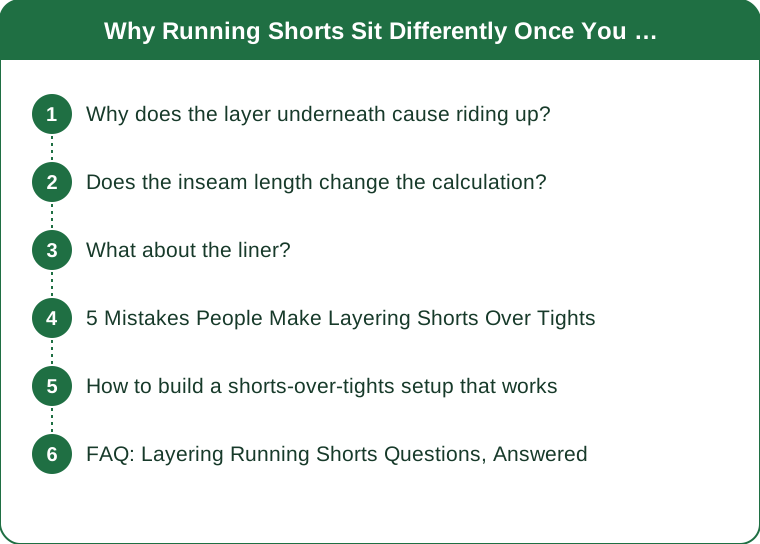
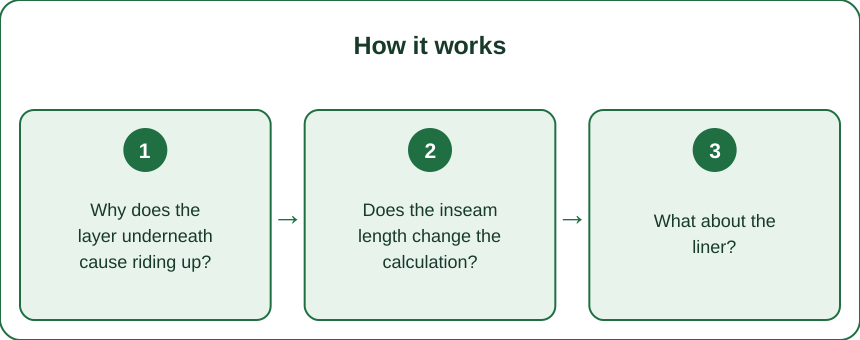
Why does the layer underneath cause riding up?
Because it removes the friction that was holding the shorts in place.
Worn against skin, running shorts rely on a low but genuine amount of friction to stay put. Skin has texture, some moisture, and enough grip to resist the small upward forces each stride produces. It is not a strong anchor, but it is enough that a well-fitting short stays roughly where you put it.
Running tights are made from smooth nylon or polyester elastane blends, frequently with a slick face finish. That surface has a considerably lower coefficient of friction than skin. The shorts now sit on something that offers almost no resistance to sliding.
Each stride produces a small upward force at the inner thigh as the legs cross. Against skin, that force is largely resisted. Against tights, it is not, and the movement is cumulative. Fifty strides produce nothing noticeable; two thousand produce shorts sitting a good deal higher than they started.
The waistband takes the consequence. As the legs of the shorts creep upward, they pull the waistband and the whole garment rotates and bunches — which is why the complaint usually arrives as twisting rather than simply riding up.
Does the inseam length change the calculation?
Substantially, and in a way that reverses the usual summer advice.
Over bare skin, a shorter inseam is often the better anti-chafe choice, because it keeps the hem above the point where the thighs make contact. That logic depends on skin-to-skin or skin-to-fabric contact at the inner thigh.
Over tights, everything changes. The tights are already handling the skin contact entirely, so chafing between the thighs is no longer the shorts’ problem. What matters instead is how much fabric length there is to resist migration, and a longer leg has more.
A 3-inch short over tights sits high to begin with and has very little distance to travel before it is bunched at the top of the thigh. A 5 to 7-inch short starts lower, has more contact area, and its own weight works slightly in its favour.
Split-leg shorts are the hardest case of all, since the split reduces the effective anchoring length even further.
So the short you loved in July may genuinely be the wrong choice in October, without being a worse short. This is also why so many runners quietly own a separate pair of longer shorts they only wear from September onwards, without ever articulating why.
What about the liner?
It becomes redundant, and redundant is not neutral.
Most running shorts have a built-in liner, which does real work against skin — managing moisture and preventing chafe. Worn over tights it does none of those things, because the tights are already doing them.
What the liner does instead is add a second layer of slippery synthetic against the tights, which makes the migration worse rather than better. The liner slides on the tights, the shell slides on the liner, and now there are two interfaces with almost no friction between them.
It also adds bulk at the waistband, which is where the layering already creates the most compression. Three waistbands — tights, liner, shell — sitting at approximately the same height is the most common source of the specific discomfort people report when they start layering.
A few practical responses:
- Choose unlined shorts for layering if you have them. They are usually sold as split shorts, race shorts, or simply as shells.
- Stagger the waistband heights. Tights high, shorts slightly lower, so the compression is not all at one point.
- Cut the liner out of an old pair. Unglamorous, effective, and reversible only in one direction.
The liner is a summer feature. In a layered setup it is dead weight with a friction penalty.

5 Mistakes People Make Layering Shorts Over Tights
1. Sizing the shorts down to stop them riding. Tighter shorts on a slippery surface still slide, and now the waistband compression is worse. Grip is the missing variable, not size.
2. Keeping the 3-inch shorts from summer. The shortest inseam in your drawer is the worst layering option available. Save it for July.
3. Stacking all three waistbands at the same height. Tights, liner and shell all sitting at your natural waist creates a compression band that becomes genuinely uncomfortable over an hour.
4. Assuming the chafe is from the shorts. Once you are layering, chafing at the inner thigh is nearly always a tights seam, not the shorts. Check the tights first.
5. Choosing the slipperiest tights you own. This is the one nobody thinks about — a matte or brushed-face tight grips shorts noticeably better than a glossy compression tight, and swapping the tights fixes the shorts more reliably than swapping the shorts does.
How to build a shorts-over-tights setup that works
Start from the bottom layer, which is where the fix actually lives.
Choose tights with a matte or brushed face. Glossy compression fabrics are the slipperiest option and the hardest to layer over. A brushed or lightly textured surface gives the shorts something to hold.
Pick shorts with a 5 to 7-inch inseam. More contact length, less migration, and no downside now that the tights are handling thigh contact.
Prefer a wide, flat waistband — ideally with silicone grip on the inside. That grip does the job skin used to do, and it is the single most effective feature for this specific problem.
Go unlined if you can, or stagger the waistband heights if you cannot.
Size the shorts normally. Resist the instinct to size down.
Check the tights’ seam placement. With the shorts on top, an inner-thigh seam on the tights is now the closest thing to your skin at the highest-friction point, and it will be what chafes.
Do a two-minute test at home. Put the layers on and run up and down the stairs. Migration that takes two miles outside shows up in thirty seconds on stairs.
And one practical note for the season: the temperature at which layering makes sense is narrower than people expect — roughly 4 to 12°C for most runners. Below that, tights alone are usually warmer than the layered setup, because the shorts add negligible insulation and considerable faff.
FAQ: Layering Running Shorts Questions, Answered
Why do I even wear shorts over tights?
Coverage and preference, mostly, plus pocket access and a bit of wind protection at the hip. There is no performance argument for it, which is fine — comfort in what you are wearing is a real factor in whether you go out.
Should the shorts be tighter or looser than the tights?
Looser, and normally sized. The tights provide compression; the shorts provide coverage. Two compressive layers at the same point is uncomfortable and does nothing useful.
Do silicone grippers on the shorts hem help?
On the hem, only marginally, and they can dig in. At the waistband they help a great deal, since that is where the anchoring needs to happen.
Is there a temperature where this stops making sense?
Below about 4°C most people are better in a warmer single tight than in shorts over a lighter one. Above about 12°C the tights are usually unnecessary.
Can I wear shorts over capri-length tights?
Yes, and it is often easier, since the shorter tight gives your shorts more skin contact at the upper thigh in some positions. Watch the hem line — a capri hem sitting just below a shorts hem is a chafe point some people notice.
TL;DR:
- Shorts stay put against skin because skin grips; tights are slippery and remove that anchor
- Choose a 5 to 7-inch inseam for layering — the short inseams that work in summer are the worst option in autumn
- The liner becomes redundant and adds a second frictionless interface, so unlined shells layer better
- A wide waistband with silicone grip replaces the grip your skin used to provide
- Matte or brushed-face tights hold shorts far better than glossy compression fabrics
Before you buy new shorts, try the pair you own over a different pair of tights. The layer underneath is doing more of the work than the layer on top, and swapping it is the cheaper experiment.
Keep Reading
This article is for general informational and styling purposes only. Fit, sizing, and product availability may vary.