How Running Shorts Pocket Placement Quietly Affects Your Stride
Quick Answer: Pocket placement affects running shorts comfort more than most runners expect — rear waistband pockets tend to bounce with each stride, side thigh pockets can restrict the natural arm-leg counter-swing at higher mileage, and front-liner pockets sit closest to the body’s center of mass and bounce the least, making them the most stride-neutral option for longer runs.
The shorts fit fine standing in the mirror. Two miles in, though, a phone in a rear pocket has developed its own rhythm, slightly out of sync with footstrike, and the brain starts quietly compensating for it without even realizing why the stride feels a touch off.

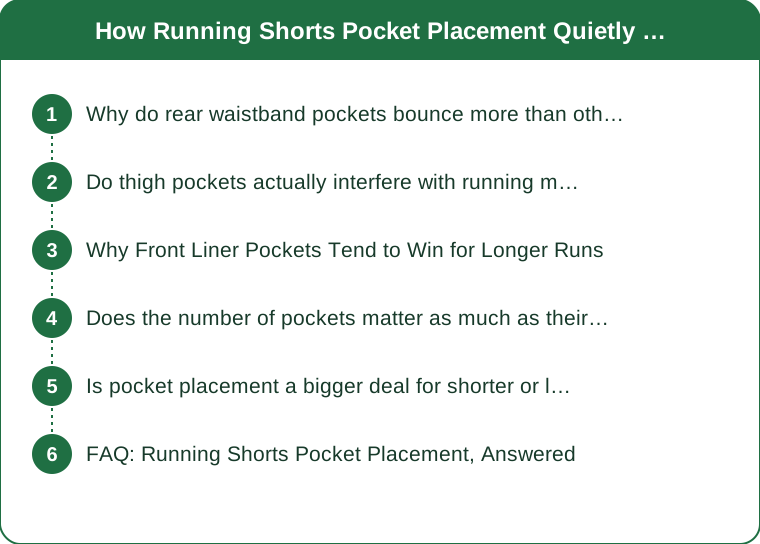
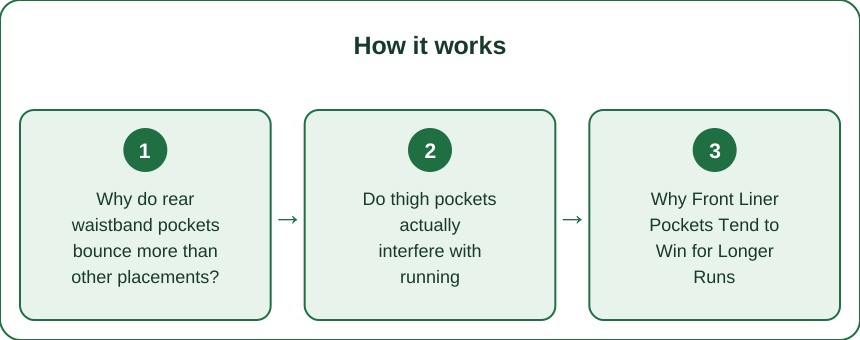
Why do rear waistband pockets bounce more than other placements?
Rear pockets sit furthest from the body’s center of mass and highest above the hip’s natural rotation point, so with each stride the pocket’s contents (phone, keys, gel) experience more leverage and swing further from the body than the same item would in a pocket positioned closer to the hip or thigh, which is why rear-pocket bounce tends to become noticeable specifically as pace or distance increases.
Do thigh pockets actually interfere with running mechanics?
A snug, well-designed thigh pocket usually doesn’t meaningfully restrict stride, but a loose or overstuffed one can create light drag against the leg during the swing phase of each stride, and over many miles that small resistance is enough to register as mild irritation or a subtle change in leg swing rhythm, even if it wouldn’t be noticeable in a short test jog.
Why Front Liner Pockets Tend to Win for Longer Runs
Pockets built into the liner at the front of the waistband sit closest to the body’s actual center of mass and lowest point of rotation during a stride, meaning contents move the least relative to the body’s overall motion — this is the same principle race vests and belts use, positioning cargo as close to center as possible, which is why minimalist front-liner pockets tend to disappear from awareness fastest on long runs compared to rear or side placements.

Does the number of pockets matter as much as their location?
Location generally matters more than count — a single well-placed front pocket carrying a phone comfortably often outperforms multiple rear or side pockets that scatter weight and create several independent bounce points, so when choosing shorts, checking where the pocket sits relative to the hip matters more than how many pockets the product page lists.
Is pocket placement a bigger deal for shorter or longer runs?
The effect compounds with distance and pace — a placement that feels completely unnoticeable during a two-mile easy jog can become genuinely distracting by mile eight or during faster tempo efforts, so runners training primarily for shorter, easier runs have more flexibility in pocket choice than those regularly running long distances or at race pace.
FAQ: Running Shorts Pocket Placement, Answered
Are zippered pockets better than open ones regardless of placement?
Zippered pockets prevent items from falling out but don’t inherently reduce bounce — placement still matters more than closure type for how much a pocket’s contents move during a run.
Is it worth avoiding pockets entirely and using a separate running belt instead?
For very long runs or races, a dedicated belt or vest often outperforms any built-in short pocket since it distributes weight more evenly, but for everyday training runs a well-placed front pocket is usually sufficient.
Does carrying a larger phone change which pocket placement works best?
Yes — larger phones amplify the bounce and drag issues of rear and side pockets more than smaller items, making a snug front-liner pocket or separate arm band a more reliable choice for bigger phones on longer runs.
TL;DR:
- Rear waistband pockets tend to bounce the most since they sit furthest from center of mass
- Loose thigh pockets can create mild drag during the leg’s swing phase over long distances
- Front liner pockets, closest to the body’s center, tend to disappear from awareness fastest
- The effect compounds with distance, mattering more on long runs than short easy jogs
A pocket that felt like a non-issue in the store is worth reconsidering once actual mileage enters the picture — where it sits relative to the hip predicts how it’ll behave far better than how many pockets the shorts have.
Keep Reading
This article is for general informational and styling purposes only. Fit, sizing, and product availability may vary.