Compression Liner vs Boxer Liner: The Difference That Actually Affects Your Run
Quick Answer: A compression liner sits snug against the skin and moves with your body, minimizing the fabric-on-skin friction that causes chafing, while a looser boxer-style liner can bunch or shift during a run, creating exactly the kind of repeated rubbing that leads to inner-thigh irritation — for most runners, especially on longer distances, a compression liner reduces chafing risk more reliably.
Both liner types promise to prevent chafing on the box. Only one of them is actually built around that specific mechanism.
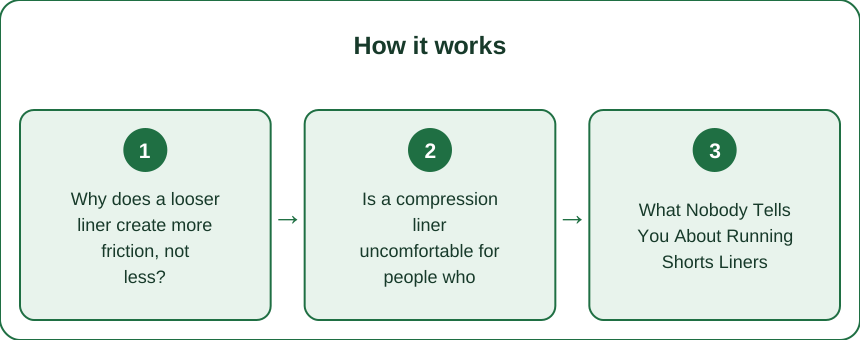
Why does a looser liner create more friction, not less?
A boxer-style liner has extra fabric that can shift and fold as your legs move, and every fold or shift creates a new point of repeated skin-on-fabric contact over the course of a run. A compression liner, by staying snug and moving as one unit with your skin, eliminates most of that internal movement — there’s simply less loose fabric available to rub.
Is a compression liner uncomfortable for people who dislike tight clothing?
It can take an adjustment period, especially for runners used to looser gym shorts, but most people report the tightness becomes unnoticeable within a few runs while the reduced chafing remains noticeable the whole time. If snugness at the upper thigh specifically feels restrictive, sizing up one size in the liner (not the outer short) often solves it without sacrificing the anti-chafe benefit.
What Nobody Tells You About Running Shorts Liners
The liner fabric matters as much as the style. A compression-cut liner made from a rough or non-wicking fabric can still chafe, just from a different mechanism (moisture retention instead of movement). Checking that the liner is a moisture-wicking material, not just checking the cut, is a step a lot of shoppers skip.
Does distance change which liner type makes more sense?
For runs under 30-40 minutes, the difference is often negligible — either liner type is fine for most people at that distance. Past an hour, the cumulative friction advantage of a compression liner becomes more noticeable, which is part of why compression liners are more common in shorts specifically marketed for long-distance and marathon training.
TL;DR:
- Compression liners stay snug and move with your skin, reducing the friction that causes chafing
- Boxer-style liners have more loose fabric, which can shift and create repeated rubbing points
- Liner fabric (moisture-wicking or not) matters as much as the cut itself
- The difference matters most on runs past an hour; shorter runs are fine with either
The liner style isn’t a comfort preference alone — it’s a friction mechanism, and one of the two options is built to minimize it directly.
Keep Reading
This article is for general informational and styling purposes only. Fit, sizing, and product availability may vary.