Why Your Running Shorts Ride Up Every Single Run (and the Real Fix)
Quick Answer: Shorts ride up mainly from thigh friction and a loose waistband combination, not from the wrong size alone — a wider waistband and the right inseam length for your stride fix it faster than sizing up or down.
You tug them down at every stoplight and they’re back up your thigh before the next block. It’s not just you, and it’s not really about the size on the tag.

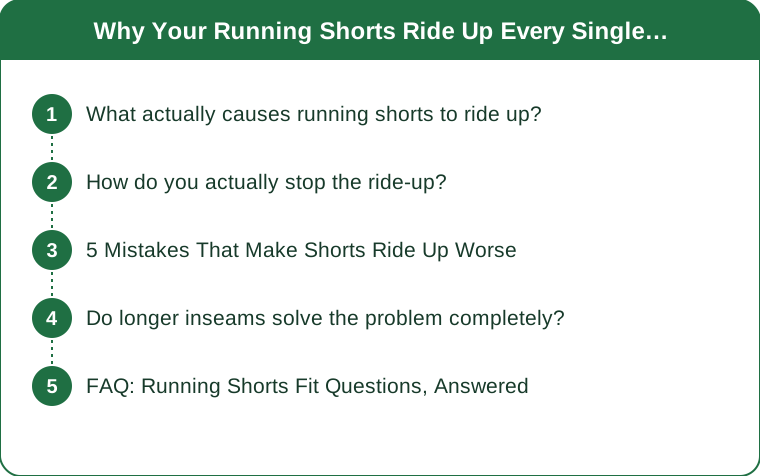
What actually causes running shorts to ride up?
Two things combine: thigh-on-thigh friction pushes fabric upward with every stride, and a waistband that isn’t snug enough lets the whole short migrate up in response. Shorter inseams (2-3 inch) tend to ride up more than longer ones (5-7 inch) simply because there’s less fabric anchoring against your leg.
Runners with thicker thighs often notice this more, not because of body type being a problem, but because there’s simply more surface area creating upward friction with each stride.
How do you actually stop the ride-up?
Look for shorts with a wider, higher waistband (2+ inches) that sits snug without digging in — a narrow waistband has less surface area to stay put. Built-in compression liners also help by reducing the thigh-fabric friction that pushes shorts upward in the first place.
A silicone or elastic grip strip on the inner hem (common in running-specific brands) keeps the leg opening from crawling up independently of the waistband.

5 Mistakes That Make Shorts Ride Up Worse
- Sizing down thinking tighter automatically means less movement — too tight actually rolls and bunches
- Choosing cotton-blend shorts instead of a moisture-wicking synthetic, since damp cotton grips and drags unevenly
- Skipping the liner and wearing loose shorts with nothing underneath to reduce friction
- Buying based on looks alone without checking waistband width
- Ignoring inseam length for your stride — very short inseams ride up faster for high-mileage runners
Do longer inseams solve the problem completely?
Longer inseams (5-7 inch) reduce but don’t eliminate ride-up, since waistband fit still matters more than length. The best combination is a longer inseam with a wide waistband and a light compression liner — that combination handles the friction and the migration separately instead of relying on one fix.
If you prefer shorter inseams for range of motion, prioritize the waistband and liner even more, since you’re removing the length buffer.
FAQ: Running Shorts Fit Questions, Answered
Do compression liners actually stop chafing and ride-up together?
Yes — liners reduce the thigh friction that causes both issues, since ride-up and chafing come from the same repeated rubbing motion.
Should I size up if my shorts keep riding up?
Not necessarily — sizing up a loose waistband design often makes ride-up worse since there’s more excess fabric to migrate; a snugger, wider waistband in your normal size usually works better.
Are 2-inch inseam shorts always going to ride up more?
Generally yes for repetitive motion like running, simply due to less fabric anchoring against the leg — pairing them with a liner and wide waistband minimizes it significantly.
TL;DR:
- Ride-up comes from thigh friction plus a loose waistband, not just wrong sizing
- Choose a wide (2+ inch), snug waistband over a narrow one
- Built-in liners reduce the friction that drives ride-up
- Longer inseams help but don’t replace good waistband design
Next time you shop, check the waistband width before the inseam length — it’s doing more of the work than you’d think.
Keep Reading
This article is for general informational and styling purposes only. Fit, sizing, and product availability may vary.