Why Running Shorts That Fit Great Standing Still Ride Up the Moment You Start Running
Quick Answer: A static standing fit test only checks waistband and length at rest, but running introduces repeated thigh friction, dynamic leg lift, and sweat-related fabric behavior that a stationary try-on simply can’t reveal — shorts can pass every standing check and still ride up within the first mile.
You tried them on, did a few squats in the fitting room, felt confident — and by the end of your first run outside, you’d tugged the hem back down more times than you could count.

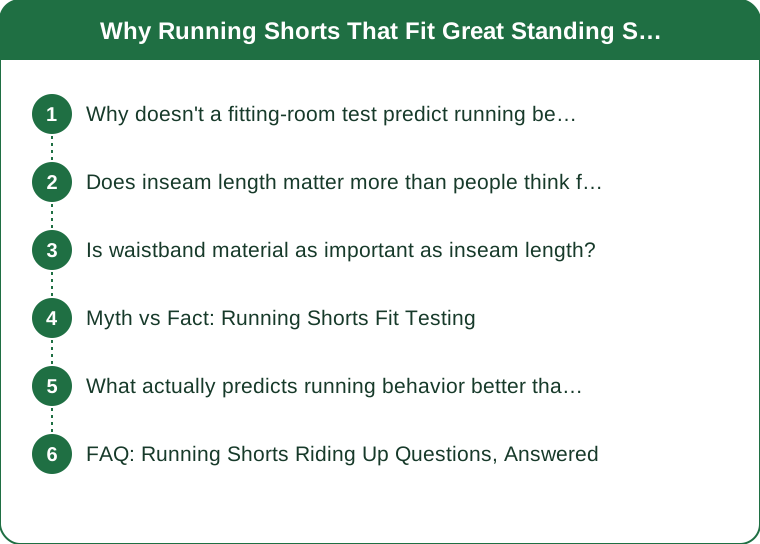
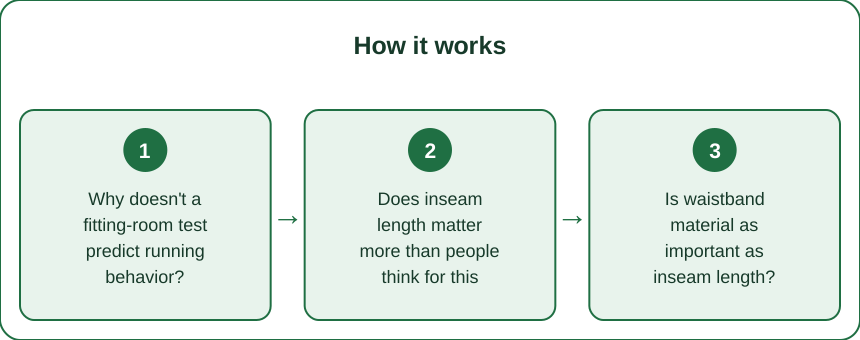
Why doesn’t a fitting-room test predict running behavior?
A few squats or lunges test a limited range of motion at low repetition, but running involves thousands of repeated hip flexion and thigh-brushing-thigh cycles over the course of a run. Fabric that shows no issue after ten fitting-room squats can still gradually work its way upward over the sustained, repetitive motion of an actual run — the failure mode only shows up at running-specific repetition volume.
Does inseam length matter more than people think for this specific issue?
Yes — shorter inseams have less fabric surface area to “grip” against the thigh during the stride, making them more prone to riding up compared to a slightly longer inseam with more contact area, even at the same waistband and overall fit quality. This is a big part of why the same brand’s slightly longer inseam option sometimes performs completely differently for the same person.
Is waistband material as important as inseam length?
Nearly as important — a silicone-gripped or wider elastic waistband stays in place through repeated hip movement better than a thin, smooth elastic band, which can gradually roll or shift with sweat and repetitive motion even if it felt secure standing still.

Myth vs Fact: Running Shorts Fit Testing
Myth: If they don’t ride up doing squats in the store, they won’t ride up running. Fact: running’s specific repetitive thigh-brushing motion at running cadence is a different stress pattern than a few squats and isn’t reliably predicted by a static fitting-room test.
Myth: A tighter fit always prevents riding up. Fact: overly tight shorts can actually ride up more if the fabric doesn’t have enough give to move with the stride — some flexibility in fit, paired with the right fabric grip, often outperforms a simply tighter fit.
What actually predicts running behavior better than a store try-on?
A short test jog (even just around the block or in place for a minute) before committing to a purchase, if returns allow it, reveals far more than static poses. Barring that, checking for a built-in liner with a wider band and grip strips at the hem are two specific features strongly associated with staying in place through actual running motion.
FAQ: Running Shorts Riding Up Questions, Answered
Does body type affect how much shorts ride up?
Somewhat — more thigh contact during the stride generally means more friction-driven riding up, which is a fabric and fit issue to solve for, not something to change about your body.
Are compression shorts a reliable fix if regular running shorts keep riding up?
Often yes — the closer, more even contact of compression fabric reduces the loose-fabric movement that causes riding up, though personal comfort preference still varies.
Does washing and wear make riding up worse over time?
Yes — elastic and grip strips lose some effectiveness after many wash cycles, so shorts that fit fine for months can start riding up more as they age.
TL;DR:
- Static fitting-room tests don’t replicate running’s repetitive thigh-brushing motion
- Longer inseams generally have more fabric contact area, reducing ride-up
- Waistband grip material matters as much as overall fit tightness
- A real test jog before committing predicts behavior far better than in-store squats
Keep Reading
This article is for general informational and styling purposes only. Fit, sizing, and product availability may vary.